

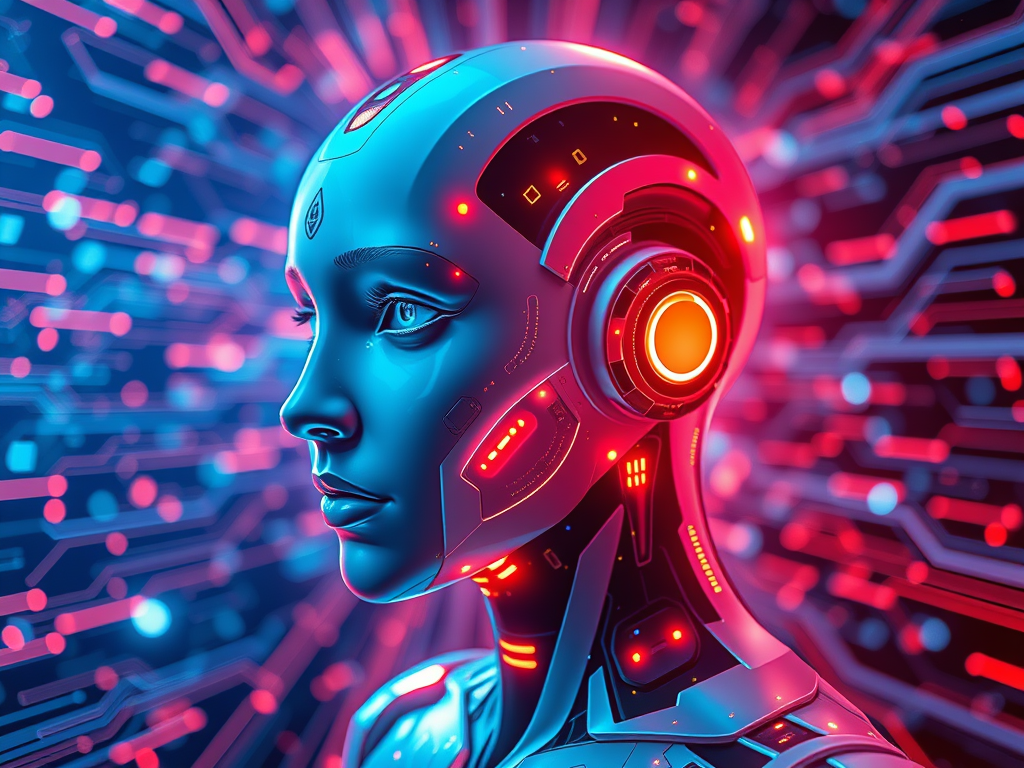
It feels like every day there’s a new AI breakthrough. A new tool, a new update, a new model. In fact, by the time you read this article, something else will have already taken the spotlight. That’s just the reality of the AI world right now—it’s moving at such a rapid pace, it’s impossible to keep up. And frankly, I find that thrilling.
Here’s the thing: I could hit “publish” on this article, and within a few days, the advancements in AI could render everything I’m about to say outdated. We’re living in a world where AI technology doesn’t just evolve—it’s accelerating at a pace so fast, it’s almost impossible to track. And it’s reshaping everything, from the way we work to how we create, to even how we think about the future.
So, let’s dive in—before this too becomes yesterday’s news.
The Exponential Growth of AI: Powered by Itself and Moore’s Law
We’ve entered an era where AI is not only advancing quickly—it’s learning to advance faster. Think of it as technology running on an exponential treadmill, where each breakthrough builds on the last, and the speed keeps picking up. The way AI evolves mirrors the trends we’ve seen in hardware advancements, particularly those under Moore’s Law. For years, Moore’s Law predicted that the number of transistors on a microchip would double roughly every two years, leading to exponential improvements in processing power. Now, AI is creating a similar cycle of self-improvement.
Just as hardware advancements fueled the growth of AI tools like GPT-3, we’re now seeing AI train itself to create faster, smarter models. Each new iteration of AI isn’t just faster; it’s more capable of advancing even more quickly. So, AI is rapidly scaling in ways that are both fueled by hardware and catalyzed by its own learning curve. The more data it processes, the smarter it gets, and the faster it progresses. It’s a perfect storm of exponential growth.

Why the Speed of AI Matters (And Why It’s So Exciting)
Sure, the speed of AI innovation can feel overwhelming. With each new breakthrough, there’s a strange mix of excitement and anxiety. It’s thrilling because we’re witnessing history unfold in real-time. AI is reshaping industries at a scale we’ve never seen before—whether it’s automating mundane tasks, creating new forms of art, or improving critical areas like healthcare, finance, and education.
But here’s where it gets interesting: The speed at which AI evolves is not just about what it can do today—it’s about the future it’s shaping. In the past, technological progress was largely dependent on human input and iteration. With AI, the software itself is accelerating, learning faster, and optimizing its own performance.
Take the GPT series, for example. GPT-3, which arrived in 2020, stunned us with its ability to generate human-like text. But now, with GPT-4, the bar has been raised. GPT-4 has improved accuracy, creativity, and understanding of nuance. And what’s next? Rumors are already swirling about GPT-5, or possibly something even more transformative, as models continue to push the boundaries of what’s possible.
AI in the Creative Industry: More Than Just Automation
One of the most visible areas where AI is evolving is in creative industries. Tools like GPT-4, DALL·E, and MidJourney have revolutionized art, writing, and design. These platforms are no longer just about automating tasks—they’re evolving into collaborators in the creative process. AI can help brainstorm, refine, and even generate content entirely, making it a partner rather than a tool.
But the more advanced AI gets, the more it challenges traditional notions of creativity. If an AI can generate a painting or write an article indistinguishable from human output, what does that mean for human creators? As AI becomes increasingly adept at producing original works, we’re forced to reconsider the very definition of creativity. Is AI simply a tool in the hands of creators, or is it reshaping the idea of who or what a creator really is?
For more on this shifting landscape, check out our article The Future of Design in the Age of AI, where we explore how AI is not only shaping creativity but reimagining the entire design process.
AI’s growing presence in creative industries highlights a broader trend: the line between human and machine is blurring. As AI continues to refine its abilities, we must grapple with what it means to be a creator in an age where intelligent machines are part of the creative ecosystem.

The Future of AI: What’s Next?
So, what’s next for AI? Will we hit a plateau, or is the acceleration just getting started? The reality is, we’re in uncharted territory. While no one can predict the future of AI with certainty, one thing is clear: AI will continue to evolve, and its integration into our personal and professional lives will deepen. With technologies like reinforcement learning, generative models, and deep neural networks, we’re not just improving existing systems—we’re opening up entirely new possibilities.
We could soon see AI in everyday applications we’ve yet to fully imagine. It’s likely that within a few years, AI will be so seamlessly integrated into our lives that we’ll stop thinking of it as a separate technology. Instead, it’ll be as ubiquitous as the internet, quietly enhancing everything from the way we work, to the way we create, to the way we make decisions.

The Speed of AI is Both a Challenge and an Opportunity
The rapid pace of AI advancements is both thrilling and daunting. It’s tough to keep up with the continuous wave of innovation, but that’s what makes this time so exciting. We’re living through a technological revolution that’s transforming every sector, from healthcare to entertainment to finance.
Sure, AI might seem like it’s always ahead of us, but there’s a certain thrill in the chase. Every new development, every improvement in capability, brings us closer to a future we could only dream about a few years ago. The key is to keep evolving alongside AI—to embrace it as a tool for innovation and progress.
Even though AI might outpace us at times, we have the opportunity to shape how it integrates into our world. The rapid pace is both a challenge and an opportunity, but one thing’s for sure: the future of AI is happening now, and it’s a future that’s arriving faster than we ever imagined.
So, while this post may already be outdated by the time you read this, I think that’s the point.
AI is evolving too quickly to stand still. And if we want to stay part of the conversation, we’ll have to keep moving with it. The future of AI is unfolding at lightning speed. And whether you’re a creator, a developer, or a curious observer, there’s never been a more exciting time to be part of this revolution.
You must be logged in to post a comment.